A washing machine that stops mid-cycle with a drum full of water is a problem that cannot wait until tomorrow — especially in a Sharjah home where the laundry never really stops. If you are new to the Emirates, UAE Travel Brief is a useful first read on daily life here; this guide stays on the washing machine: the faults technicians see most, the checks that are safe at home, and how to tell a small repair from a machine that is not worth saving.
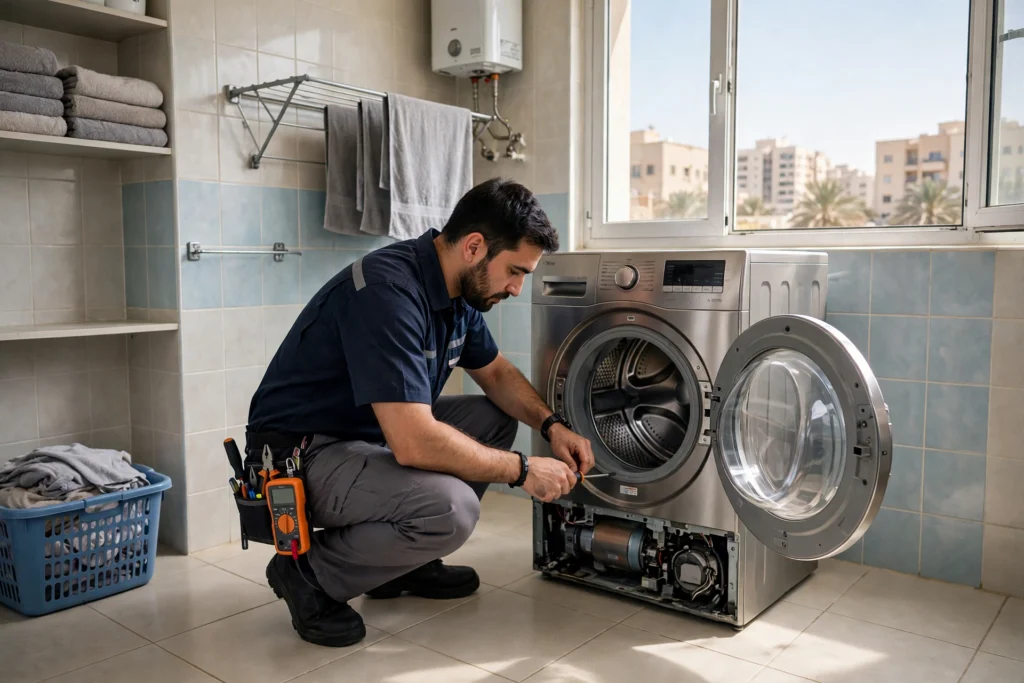
Most washing machine call-outs fall into a handful of patterns, and telling them apart is what keeps a small repair small.
A machine that will not drain is the most common. The drum sits full of water, the cycle will not finish, and the door will not open. In most cases the cause is a blocked drain pump filter — a small cap at the bottom front of the machine that collects coins, buttons and lint. It is a routine fix, but it needs doing properly: the water has to go somewhere, and a flooded laundry room is worse than a blocked filter.
A machine that shakes, walks across the floor or sounds like a bag of bolts is usually a levelling problem or a worn shock absorber. Front-loaders spin fast, and if the machine is not level — or if the transit bolts were never removed when it was installed — the drum hammers itself to pieces over time. A machine that has started moving needs attention quickly, because every violent spin shortens the life of the bearings.
A machine that leaks is usually a door seal, a loose hose connection, or a cracked drain hose. A torn door seal is visible if you know where to look: run a finger around the rubber bellows and feel for splits, especially at the bottom where water sits. A leak from underneath is different — it can mean a failed pump or a split internal hose, and it should be checked the same day, because a slow leak damages flooring before anyone notices.
A machine that fills but never starts washing usually has a door lock fault — the machine will not run unless it knows the door is safely shut. A machine that fills continuously and never stops usually has a faulty water inlet valve or a pressure switch problem. Both are diagnosed with a meter, not guessed at.
And a machine that is completely dead — no lights, no display — is usually a blown fuse, a failed door lock, or a control board problem. A fuse is a small repair; a board is a bigger one, and an honest technician will say so before ordering the part.
There are four checks worth doing before you call anyone.
First, clean the drain pump filter. Put a towel and a shallow tray under the small flap at the bottom front, open it slowly, and let the water out. Unscrew the filter, clear out whatever is in it, and screw it back firmly. This one check solves a surprising number of “will not drain” call-outs.
Second, check the load. An unbalanced load — one heavy towel, or a single pair of jeans — will make the machine refuse to spin. Redistribute the load evenly, add a couple of similar items, and try the spin cycle again.
Third, check the machine is level. Press down on opposite corners; if it rocks, adjust the feet until it sits solid. A machine that rocks wears its bearings and shock absorbers unevenly, and the repair that follows is far more expensive than a minute with a spanner.
Fourth, check the water supply and the drain hose. Make sure both taps are fully open, the inlet hose is not kinked behind the machine, and the drain hose is not pushed too far down the standpipe. A kinked hose is an easy miss and a free fix.
If none of these helps, stop there. Opening a washing machine means working around mains wiring, a water supply and a heavy drum — a wrong guess can turn a simple repair into a flooded room or a damaged control board.
Front-loaders are the common choice here, and their weak points are the door seal, the drain pump and the bearings. A front-loader that has become loud on spin — a rumbling that grows over weeks — usually has worn bearings, and that is a repair to catch early. Left alone, worn bearings damage the drum itself, and the repair goes from worthwhile to not worth it.
Top-loaders are simpler machines with fewer parts to fail, but their agitator and gearbox wear over time, and a top-loader that fills and drains at the same time usually has a drain hose positioned wrong or a failed valve. Either way, the diagnosis takes minutes for a technician with the right tools.
It follows the part. A drain pump filter clean, a door seal, a door lock or a drain hose are all modest jobs — washing machine repairs with us start from AED 110. A motor, a control board or a set of bearings costs considerably more, and on a very old machine the honest advice may be that a replacement makes more sense. That is the conversation a diagnosis-first visit is for: the fault is found, the price is explained in plain terms, and you decide with real numbers in front of you. Every repair we carry out is backed by a 90-day warranty.
Our other guides follow the same approach. If the rest of the home is giving trouble, our Microwave Repair Dubai guide covers microwaves that run but do not heat, and our Fridge Repair Sharjah guide covers the fridge faults that most often appear in the same homes.
A few habits add years. Clean the drain pump filter every month — it takes two minutes and prevents the most common breakdown of all. Leave the door and the detergent drawer open after a wash so the seal and the drum dry out; trapped moisture grows mould and wears the seal. Use the right amount of detergent — too much leaves residue that clogs the machine and the pipes. Run a hot empty cycle with a cup of white vinegar once a month to clear buildup. And keep the machine level; a machine that rocks is a machine wearing itself out.
In a Sharjah home where the machine runs most days, those small habits are the difference between a machine that lasts five years and one that lasts ten.
My washing machine will not drain. Is it finished?
Usually not. A blocked drain pump filter is the most common cause and a quick fix. If the filter is clear and it still will not drain, the pump itself may have failed.
The machine shakes violently on spin. What is wrong?
Usually levelling, an unbalanced load, or worn shock absorbers. Check the load and the feet first — if it still shakes, the shock absorbers or bearings need a technician.
There is water leaking from my washing machine. Is that serious?
Yes, get it checked the same day. A torn door seal or a loose hose is a routine fix, but a slow leak can damage flooring for days before anyone notices.
Is it worth repairing an old washing machine?
If the fault is a seal, a lock, a hose or a pump, yes. If the bearings or the control board have failed on a very old machine, ask the technician honestly whether a replacement is better value.
How quickly can a washing machine be repaired in Sharjah?
Most common faults are fixed in a single visit once diagnosed. Repairs start from AED 110 with a 90-day warranty — call +971 55 667 3225 or email info@acrefrigeratorrepairdubai.com to book a visit.
Our certified mobile technicians reach your home in Dubai, Sharjah, Ajman & Abu Dhabi within 30 minutes with a 90-day warranty!
Certified HVAC & Home Appliance Engineers with 10+ years field experience across Dubai, Sharjah, Ajman, and Abu Dhabi.